06/05/2026
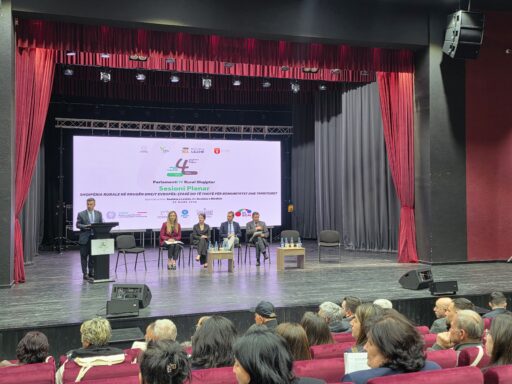
A joint intervention by two of FOLOU’s Albanian twinning regions partners —YPARD Albania and IAM— brought the food loss agenda to one of the country’s most influential rural policy platforms, catalyzing dialogue, strengthening capacities, and setting the foundation for tangible field-level action.
Food loss in Albania remains a persistent and economically significant challenge. Yet, at farm level, it is still largely invisible, rarely measured, insufficiently understood, and often accepted as an unavoidable cost of agricultural production. This is precisely the paradigm that YPARD Albania and the Institute for Albanian Municipalities (IAM) sought to challenge through their joint contribution at the Fourth Session of the Albanian Rural Parliament.
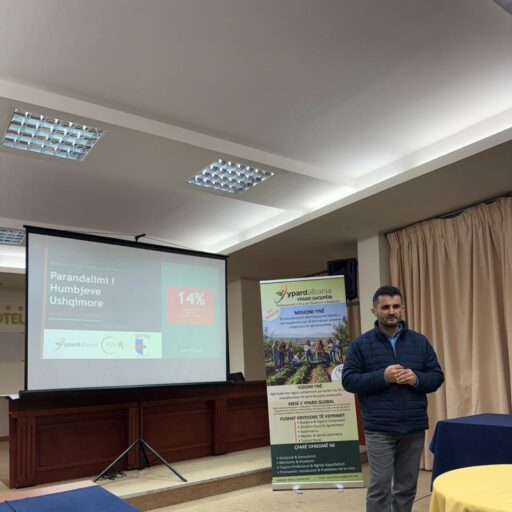
As two of the nine entities engaged in the FOLOU Twinning Regions Programme, YPARD Albania and IAM delivered a structured and evidence-based presentation on food loss prevention at farm level. The session introduced the FOLOU methodological framework to one of Albania’s most prominent national platforms for rural dialogue, engaging a diverse audience of young farmers, municipal representatives, agricultural experts, and development stakeholders. It stands as one of the most comprehensive outreach efforts undertaken under the programme in Albania to date.
“Measuring food loss is the first step toward managing it. What is not counted cannot be reduced, and what cannot be reduced will continue to generate economic, social, and environmental costs.”
Albania’s agricultural sector is characterized by small-scale, fragmented farm structures, constrained access to cold storage, limited post-harvest infrastructure, and weak integration into formal markets. Discussions during the session confirmed a reality long observed in the field: Food losses occur systematically across the agri-food chain, from harvest to market, yet remain largely un-quantified and insufficiently addressed.
Post-harvest stages emerged as critical loss points, particularly during storage, handling, and transportation, as well as at the point of market delivery, where quality standards and buyer requirements frequently lead to product rejection. These technical inefficiencies are further exacerbated by structural market constraints, including price volatility, the absence of forward contracting mechanisms, and limited bargaining power of farmers.
Climate variability adds another layer of vulnerability. Increasing exposure to extreme weather events, irregular precipitation patterns, and pest pressures is intensifying the risk of production and post-harvest losses, making the need for systematic intervention more urgent than ever.
The presentation provided a comprehensive overview of food loss, bridging global concepts with practical, locally applicable solutions. It guided participants through key definitions, critical loss points along the agri-food chain, and actionable mitigation strategies grounded in the FOLOU approach.
A central insight emerging from the discussion was that the FOLOU framework does not depend on large-scale investments to initiate change. On the contrary, systematic measurement, understanding where, how, and why losses occur, represents a transformative and accessible entry point for farmers and stakeholders alike.
A defining strength of Albania’s participation in the FOLOU Twinning Regions Programme lies in the complementarity of its two implementing partners.
YPARD Albania contributes strong grassroots engagement, with direct access to young farmers and rural professionals, and a proven capacity to translate technical knowledge into accessible and actionable formats. IAM brings the institutional dimension, linking food loss reduction to local governance structures, municipal planning processes, and inter-institutional coordination mechanisms.
Together, they exemplify a model of systemic change: Combining field level demand for solutions with institutional capacity to integrate, scale, and sustain them. The Rural Parliament session demonstrated that this dual approach is both credible and effective within the Albanian context.

This project has received funding from the European Union’s Horizon Europe research and innovation program, under Grant Agreement: 101084106. Views and opinions expressed are however those of the authors only and do not necessarily reflect those of the European. Neither the European Union nor the granting authority can be held responsible for them.
FOLOU is a proud partner of the Biorefine Cluster Europe.




Copyrights © 2026 | Folou.eu Cookie & Privacy Policy Webdesign & Development by ALYS